 | In Conversation: Samuel Wells and Stanley Hauerwas by Samuel Wells and Stanley Hauerwas. Publisher : Church Publishing (October 17, 2020). 144 pages. Two contemporary theologians, Samuel Wells and Stanley Hauerwas, add their voices to the ongoing conversation about Christian life in the twenty-first century.
This third book in the In Conversation series dives deeply into the theological and personal ideas and motivations for the work of two prominent Christian thinkers. Readers will discover their thoughts on the Trinity, parish ministry, and non-violence, along with anecdotes and intimate notions on marriage, family, and even baseball. Followers of Wells’s and Hauerwas’s theological and homiletical work will find out what has influenced them most, and where they’d like to go from here. These conversations spark with energy and intelligence, with candour and (often) a kind of gospel-shaped mischief. If you think there is nothing new or interesting to be said about preaching, forgiveness, race, power, marriage and sexuality, university education, think again. Stanley and Sam have a rare gift for making things fresh, turning familiar questions around and genuinely inviting you to learn, as they have so manifestly learned from their friendship. A welcome shaft of spiritual clarity in a very wintry season for Western society. -). 144 pages. |
 | The Character of Virtue: Letters to a Godson Eerdmans (April 19, 2018). 205 pages. From the fairy godmother’s pumpkin coach to Herr Drosselmeyer’s nutcracker, godparents have long been associated with good gifts. But in The Character of Virtue theologian and ethicist Stanley Hauerwas offers his real-life godson something far more precious than toys or trinkets—the gift of hard-won wisdom on life and the process of maturing. In each of sixteen letters—sent on the occasion of Laurence Wells’s baptism and every year thereafter—Hauerwas contemplates a specific virtue and its meaning for a child growing year by year into the Christian faith. Writing on kindness, courage, humility, joy, and more, Hauerwas distills centuries of religious thinking and decades of self-reflection into heartfelt personal epistles that are both timely and timeless. An introduction by Samuel Wells—Laurence’s father and Hauerwas’s friend—tells the story behind these letters and offers sage insight into what a godparent is and can be. |
 | Living Gently in a Violent World: The Prophetic Witness of Weakness IVP Books; Expanded edition (July 3, 2018). 128 pages. How are Christians to live in a violent and wounded world? Rather than contending for privilege by wielding power and authority, we can witness prophetically from a position of weakness. The church has much to learn from an often-overlooked community―those with disabilities. In this fascinating book, theologian Stanley Hauerwas collaborates with Jean Vanier, founder of the worldwide L'Arche communities. For many years, Hauerwas has reflected on the lives of people with disability, the political significance of community, and how the experience of disability addresses the weaknesses and failures of liberal society. And L'Arche provides a unique model of inclusive community that is underpinned by a deep spirituality and theology. Together, Vanier and Hauerwas carefully explore the contours of a countercultural community that embodies a different way of being and witnesses to a new order―one marked by radical forms of gentleness, peacemaking, and faithfulness. The authors' explorations shed light on what it means to be human and how we are to live. The robust voice of Hauerwas and the gentle words of Vanier offer a synergy of ideas that, if listened to carefully, will lead the church to a fresh practicing of peace, love and friendship. This invigorating conversation is for everyday Christians who desire to live faithfully in a world that is violent and broken. This expanded edition now includes a study guide for individual reflection or group discussion. |
 | The Work of Theology Eerdmans (August 5, 2015). 306 pages. In this book Stanley Hauerwas returns to the basics of "doing" theology. Revisiting some of his earliest philosophical and theological views to better understand and clarify what he has said before, Hauerwas explores how theological reflection can be understood as an exercise in practical reason. Hauerwas includes chapters on a wide array of topics, including "How I Think I Learned to Think Theologically," "How the Holy Spirit Works," "How to Write a Theological Sentence," and "How to Be Theologically Funny." In a postscript he responds to Nicholas Healy's recent book Hauerwas: A (Very) Critical Introduction. "What we believe as Christians," says Hauerwas, "is quite basic and even simple. But because it is so basic, we can lose any sense of the extraordinary nature of Christian beliefs and practices." In discussing the work of theology, Hauerwas seeks to recover that "sense of the oddness of what we believe as Christians." |
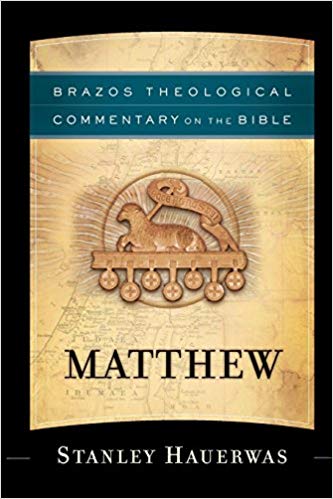 | Matthew (Brazos Theological Commentary on the Bible) Brazos Press; Reprint edition (April 21, 2015) 272 pages. |
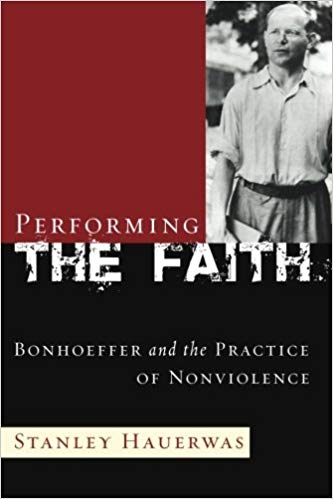 | Performing the Faith: Bonhoeffer and the Practice of Nonviolence Wipf & Stock (March 11, 2015). 252 pages. "Folksy, eclectic, disarmingly humble, and astonishingly wide-ranging, Hauerwas offers us a provocative reading of Bonhoeffer that, not surprisingly, assimilates him closely to John Howard Yoder. At the same time, Hauerwas replies to recent criticisms of his work by Jeffrey Stout. Contending that truth depends on performance far more than on theory, Hauerwas steps forward as a pacifist gadfly for a more truly faithful church and a more recognizably democratic society." --George Hunsinger, Princeton Theological Seminary |
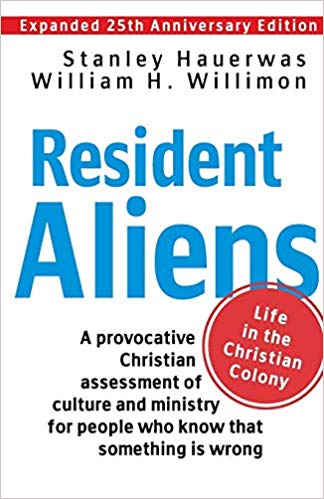 | Resident Aliens: Life in the Christian Colony (Expanded 25th Anniversary Edition) Abingdon Press; Expanded, Anniversary edition (April 15, 2014). 198 pages. Only when the Church enacts its scandalous Jesus-centered tradition will it truly be the body of Christ and transform the world. Twenty-five years after its first appearance, Resident Aliens remains a prophetic vision of how the Church can regain its vitality, battle its malaise, reclaim its capacity to nourish souls, and stand firmly against the illusions, pretensions, and eroding values of today's world. Resident Aliens discusses the nature of the church and its relationship to surrounding culture. It argues that churches should focus on developing Christian life and community rather than attempting to reform secular culture. Stanley Hauerwas and William H. Willimon reject the idea that America is a Christian nation; instead, Christians should see themselves as "resident aliens" in a foreign land. According to Hauerwas and Willimon, the role of Christians is not to transform government but to live lives that model the love of Christ. Rather than try to convince others to change their ethics, Christians should model a new set of ethics that are grounded in the life, death, and resurrection of Christ. |
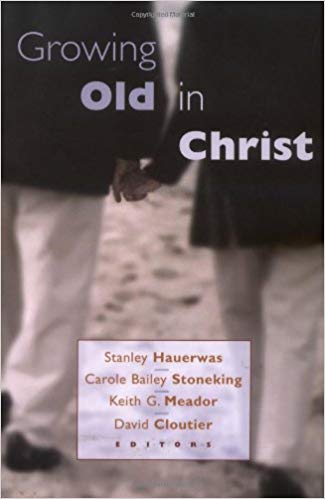 | Title Eerdmans (June 20, 2003). 310 pages. One of the hallmarks of contemporary culture is its attitude toward aging and the elderly. Youth and productivity are celebrated in today's society, while the elderly are increasingly marginalized. This not only poses difficulties for old people but is also a loss for the young and middle-agers, who could learn much from the elderly, including what it means to grow old (and die) "in Christ." |
 | Approaching the End: Eschatological Reflections on Church, Politics, and Life Eerdmans (November 28, 2013). 272 pages. In this book Stanley Hauerwas explores the significance of eschatological reflection for helping the church negotiate the contemporary world. In Part One, "Theological Matters," Hauerwas directly addresses his understanding of the eschatological character of the Christian faith. In Part Two, "Church and Politics," he deals with the political reality of the church in light of the end, addressing such issues as the divided character of the church, the imperative of Christian unity, and the necessary practice of sacrifice. End, for Hauerwas, has a double meaning -- both chronological end and end in the sense of "aim" or "goal." In Part Three, "Life and Death," Hauerwas moves from theology and the church as a whole to focusing on how individual Christians should live in light of eschatology. What does an eschatological approach to life tell us about how to understand suffering, how to form habits of virtue, and how to die? |
 | Without Apology: Sermons for Christ's Church SEABURY BOOKS (August 1, 2013). 208 pages. |
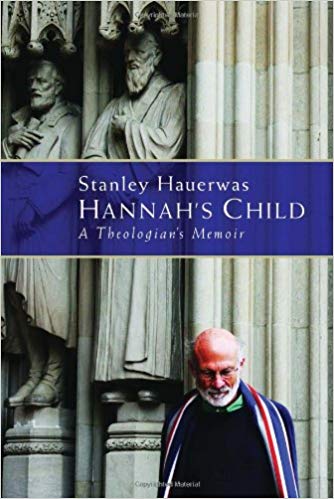 | Hannah's Child: A Theological Memoir Eerdmans; First Edition edition (April 16, 2010. 308 pages. A loving, hard-working, godly couple has long been denied a family of their own. Finally, the wife makes a deal with God: if he blesses her with a child, she will dedicate that child to God’s service. The result of that prayer was the birth of an influential -- some say prophetic -- voice. Surprisingly, this is not the biblical story of Samuel but the account of Stanley Hauerwas, one of today’s leading theologians in the church and the academy. The story of Hauerwas’s journey into Christian discipleship is captivating and inspiring. With genuine humility, he describes his intellectual struggles with faith, how he has dealt with the complex reality of marriage to a mentally ill partner, and the gift of friendships that have influenced his character. Throughout the narrative shines Hauerwas’s conviction that the tale of his life is worth telling only because of the greater Christian story providing foundation and direction for his own. |
 | War and the American Difference: Theological Reflections on Violence and National Identity Baker Academic (October 1, 2011). 208 pages. How are American identity and America's presence in the world shaped by war, and what does God have to do with it? Esteemed theologian Stanley Hauerwas helps readers reflect theologically on war, church, justice, and nonviolence in this compelling volume, exploring issues such as how America depends on war for its identity, how war affects the soul of a nation, the sacrifices that war entails, and why war is considered "necessary," especially in America. He also examines the views of nonviolence held by Martin Luther King Jr. and C. S. Lewis, how Jesus constitutes the justice of God, and the relationship between congregational ministry and Christian formation in America. |
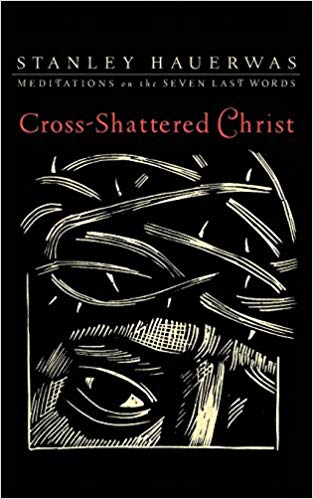 | Cross-Shattered Christ: Meditations on the Seven Last Words Brazos Press; Paperback edition edition (September 1, 2011). 108 pages. In this small but powerful book, renowned theologian Stanley Hauerwas offers a moving reflection on Jesus's final words from the cross. Touching in original and surprising ways on subjects such as praying the Psalms and our need to be remembered by Jesus, Hauerwas emphasizes Christ's humanity as well as the sheer "differentness" of God. Ideal for personal devotion during Lent and throughout the church year, this book offers a transformative reading of Jesus's words that goes directly to the heart of the gospel. Now in paperback. |
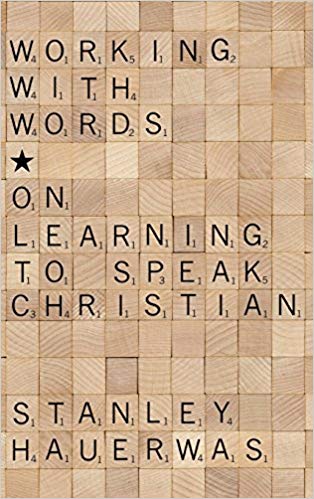 | Working with Words: On Learning to Speak Christian Wipf and Stock (February 16, 2011). 344 pages. The crucial challenge for theology is that when it is read the reader thinks, "This is true." Recognizing claims that are "true" enables readers to identify an honest expression of life's complexities. The trick is to show that theological claims--the words that must be used to speak of God--are necessary if the theologian is to speak honestly of the complexities of life. The worst betrayal of the task of theology comes when the theologian fears that the words he or she must use are not necessary. This new collection of essays, lectures, and sermons by Stanley Hauerwas is focused on the central challenge, risk, and difficulty of this necessity--working with words about God. The task of theology is to help us do things with words. "God" is not a word peculiar to theology, but if "God" is a word to be properly used by Christians, the word must be disciplined by Christian practice. It should, therefore, not be surprising that, like any word, we must learn how to say "God." ""The essays and sermons in Working with Words reveal that the vibrancy of Stanley Hauerwas arises from his single-minded, manic determination to learn from Jesus and the Scriptures to see and speak as a Christian, and to teach other Christians to do the same."" --Peter J. Leithart N |
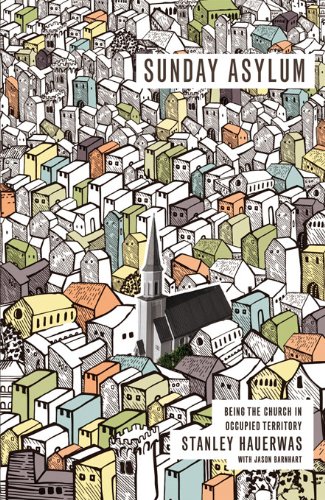 | Sunday Asylum: Being the Church in Occupied Territory The House Studio (December 1, 2010). 112 pages. We are citizens.Not of this world, but of a kingdom different from this world. A kingdom that causes us to see things through a whole new lens. So if we, the Church, are living out this kingdom, then why do the world’s culture and the Church’s culture look so similar?In this 5-week series, Stanley Hauerwas invites us to join a conversation--evaluating our role in culture and in our current church environment. Sunday Asylum will not only help you explore what it looks to be citizens of the kingdom, but will encourage you to reassess your own beliefs and motives |
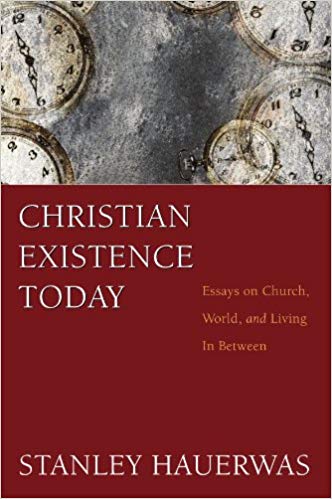 | Christian Existence Today: Essays on Church, World, and Living in Between Wipf & Stock Pub; Reissue edition (September 1, 2010). 282 pages. (Original printing 1988). Stanley Hauerwas begins this volume with a vigorous response to the charge of sectarianism leveled against his work by James Gustafson, among others. "Show me where I am wrong about God, JeWipf & Stock Pub; Reissue edition (September 1, 2010). 282 pages.sus, the limits of liberalism, the nature of the virtues, or the doctrine of the church," Hauerwas replies to his critics, "but do not shortcut that task by calling me a sectarian." The essays that follow explore in a lucid, compelling, firm, and provocative way the church's nature, message, and ministry in the world. Hauerwas writes on the church as God's new language, on clerical character, on the pastor as prophet, on the ministry of the local congregation, on grace and public virtue, and on the relation of church and university. Underlying Hauerwas's argument is his conviction that "the most important knowledge Christian convictions involve, and there is much worth knowing for which Christians have no special claim, requires a transformation of the self. Christianity is no 'world view,' not a form of primitive metaphysics, that can be assessed in comparison to alternative 'world views.' Rather, Christians are people who remain convinced that the truthfulness of their beliefs must be demonstrated in their lives. There is a sense in which Christian convictions are self-referential, but the reference is not to propositions but to lives." |
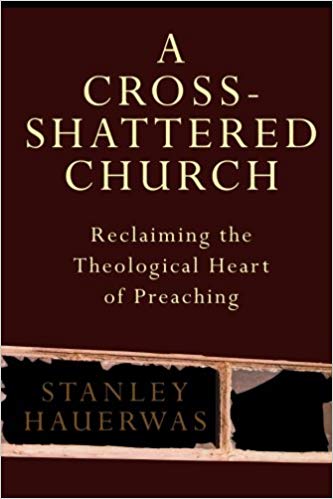 | A Cross-Shattered Church: Reclaiming the Theological Heart of Preaching Brazos Press (July 1, 2009). 160 pages. In this work, eminent theologian Stanley Hauerwas shows how the sermon is the best context for doing good theology. He writes, "I am convinced that the recovery of the sermon as the context for theological reflection is crucial if Christians are to negotiate the world in which we find ourselves." The book includes seventeen sermons preached by Hauerwas, which he considers his best theological work and hopes exemplify the work of theology. The sermons are divided into four sections: seeing, saying, living, and events. Titles range from Believing Is Seeing and Was It Fitting for Jesus to Die on a Cross? to Only Fear Can Drive Out Fear and To Be Made Human. Each sermon includes where and when it was preached and references relevant Scripture passages. Excerpt I have increasingly come to the recognition that one of the most satisfying contexts for doing the work of theology is in sermons. That should not be surprising because throughout Christian history, at least until recently, the sermon was one of the primary places in which the work of theology was done. For the work of theology is first and foremost to exposit scripture. That modern theology has become less and less scriptural, that modern theology has often tried to appear as a form of philosophy, is but an indication of its alienation from its proper work. I am, therefore, making these sermons available because I think they are not only my best theological work, but because I hope they exemplify the work of theology. |
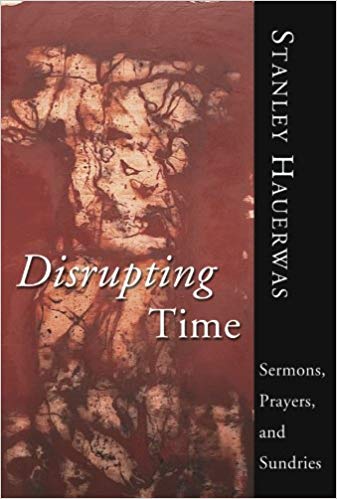 | Disrupting Time: Sermons, Prayers, and Sundries Wipf & Stock Pub (August 24, 2004). 252 pages. By his own confession, Stanley Hauerwas loves being a theologian, loves to preach, and is learning to pray. This wise and winsome collection of Sunday sermons, wedding sermons, ordination sermons, eulogies, prayers, and interviews is a gift from these loves. Offered with the grace of confidence that Jesus is who the church proclaims him to be, these "sundries" take us to the edge of an extraordinary world--comic, just, and redeemed. And most of all, they take us to a place more real than real. Both singing above his work as a teacher and provocateur and revealing the beat of faith beneath it, they voice Stanley Hauerwas's wonderful eloquence as a witness, a friend, an interlocutor, and a child of God." --Wesley Avram, Clement-Muehl Assistant Professor of Communication,Yale Divinity School |
 | Prayers Plainly Spoken Wipf & Stock Pub (January 20, 2003). 132 pages. "If anything, these prayers are plain. They are so because I discovered I could not pray differently than I speak. In other words, I thought it would be a mistake to try to assume a different identity when I prayed. I figured Texans 'figure' that God could take it, because God did not need to be protected. I think I learned this over the years by praying the Psalms in church. God does not want us to come to the altar different from how we live the rest of our lives. Therefore I do not try to be pious or use pious language in these prayers. I try to speak plainly, yet I hope with some eloquence, since nothing is more eloquent than simplicity" So writes Stanley Hauerwas in the introduction to this collection of prayers, as inimitable as the widely respected (and argued with) theologian himself. Originally prayed in Hauerwas' divinity school classroom - on a variety of occasions including war, births, Yom Kippur and the death of a beloved cat - they not only display an invigorating faith but demonstrate how late-modern Christians can pray with all the passion, turbulence and life of the ancient psalmists. |
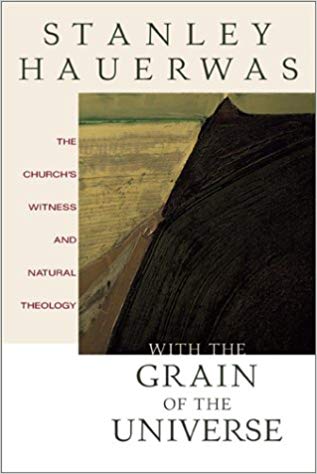 | With the Grain of the Universe: The Church's Witness and Natural Theology Brazos Press; First Edition edition (October 1, 2001). 256 pages. These lectures explore how natural theology, divorced from a confessional doctrine of God, inevitably distorts our understanding of God's character and the world in which we live. Hauerwas criticizes those who use natural theology to defend theism as the philosophical prerequisite to confessional claims. Instead, after Karl Barth, he argues that natural theology should witness to "the non-Godforsakeness of the world, even under the conditions of sin." Stanley Hauerwas has good news for the church: theology can still tell us something significant about the way things are. In fact, the church is more than a social institution, and the cross of Christ, never peripheral, is central to knowing God. Whatever our native moral intelligence, the truth that is God is not available apart from moral transformation. Ultimately--and despite the scars left by modernity--theology must translate into a life transformed by confession and the witness of the church. |
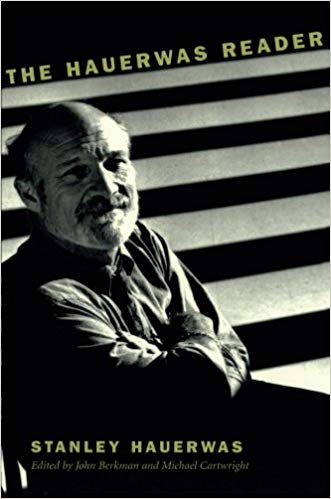 | The Hauerwas Reader by Stanley Hauerwas (Author), John Berkman (Editor), Michael G. Cartwright (Editor) Duke University Press Books; 1st edition, paperback issue, edition (July 23, 2001). 729 pages. Stanley Hauerwas is one of the most widely read and oft-cited theologians writing today. A prolific lecturer and author, he has been at the forefront of key developments in contemporary theology, ranging from narrative theology to the “recovery of virtue.” Yet despite his prominence and the esteem reserved for his thought, his work has never before been collected in a single volume that provides a sense of the totality of his vision. The editors of The Hauerwas Reader, therefore, have compiled and edited a volume that represents all the different periods and phases of Hauerwas’s work. Highlighting both his constructive goals and penchant for polemic, the collection reflects the enormous variety of subjects he has engaged, the different genres in which he has written, and the diverse audiences he has addressed. It offers Hauerwas on ethics, virtue, medicine, and suffering; on euthanasia, abortion, and sexuality; and on war in relation to Catholic and Protestant thought. His essays on the role of religion in liberal democracies, the place of the family in capitalist societies, the inseparability of Christianity and Judaism, and on many other topics are included as well. Perhaps more than any other author writing on religious topics today, Hauerwas speaks across lines of religious traditions, appealing to Methodists, Jews, Anabaptists or Mennonites, Catholics, Episcopalians, and others. |
 | A Better Hope: Resources for a Church Confronting Capitalism, Democracy, and Postmodernity Brazos Press (December 1, 2000). 288 pages. By his own admission never one to duck a good fight, Stanley Hauerwas has in the past three decades established himself as one of our most important and most disputatious theologians. With A Better Hope, he concentrates on the constructive case for the truth and power of the church and its faith, "since Christians cannot afford to let ourselves be defined by what we are against. Whatever or whomever we are against, we are so only because God has given us so much to be for." Hauerwas here crystallizes and extends profound criticisms of America, liberalism, capitalism, and postmodernism, but also identifies unlikely allies (such as Chicago Archbishop Francis Cardinal George) and locates surprising resources for Christian survival (such as mystery novels). Interlocutors along the way include Reinhold Niebuhr, John Courtney Murray, and, in a significant and previously unpublished essay, social gospeller Walter Rauschenbusch. Never boring and often telling, A Better Hope demonstrates how a thinker so often accused of being "tribal" and "sectarian" is at the same time one of few contemporary theologians read not just by other theologians, but by political scientists, philosophers, medical ethicists, law professors, and literary theorists. |
 | The Truth About God: The Ten Commandments in Christian Life Abingdon Press (April 1, 1999). 112 pages. Two popular authors consider not only what the Ten Commandments say about the people who observe them, but what they say about God. They are not some set of universal rules-they simply offer ways for a certain people to know a certain God-our God. What truths about God can be known through the Ten Commandments? God cares how we treat other people. God cares how we behave in marriage. God cares about the importance of being truthful. God wants people to take a day off from work each week. Readers will encounter Willimon and Hauerwas at their best as they explore the overarching question-What does it mean for people and the way they behave when they know some of these truths about God? |
 | Sanctify Them in the Truth: Holiness Exemplified Abingdon Press (January 1, 1999). 264 pages. Hauerwas argues that the truth of the gospel cannot be discovered apart from its embodiment in specific communities of faith. The Christian life, he argues, is not about being in possession of "the truth," defined as a set of timeless and universal principles of belief and action. Rather, it is about learning and living the life of truthfulness toward God and one another. |
 | Why Narrative? Readings in Narrative Theology Wipf & Stock Pub (October 1, 1997). 376 pages. Narrative Theology is still with us, to the delight of some and to the chagrin of others. 'Why Narrative?" is in reprint because it represents what is still a very important question. This diverse collection of essays on narrative theology has proven very useful in university and seminary theology classes. It is also of great use as a primer for the educated layperson or church study group. Jones and Hauerwas have done an excellent job of selecting representative essays that deal with appeals to narrative in areas such as personal identity and human action, biblical hermeneutics, epistemology, and theological and ethical method. |
 | Wilderness Wanderings: Probing Twentieth-century Theology And Philosophy Westview; 1st US Ed edition (September 25, 1997). 272 pages. Wilderness Wanderings slashes through the tangled undergrowth that Christianity in America has become to clear a space for those for whom theology still matters. Writing to a generation of Christians that finds itself at once comfortably “at home” yet oddly fettered and irrelevant in America, Stanley Hauerwas challenges contemporary Christians to reimagine what it might mean to “break back into Christianity” in a world that is at best semi-Christian. While the myth that America is a Christian nation has long been debunked, a more urgent constructive task remains; namely, discerning what it may mean for Christians approaching the threshold of the twenty-first century to be courageous in their convictions. Ironically, reclaiming the church's identity and mission may require relinquishing its purported “gains”—which often amount to little more than a sense of comfort, the seduction of feeling “at ease in Zion”— to take up again the risk and adventure of life “on the way.” Accordingly, this book gives no comfort to the religious right or left, which continues to think Christianity can be made compatible with the sentimentalities of democratic liberalism.Such a re-visioned church will not establish itself through conquest or in a reconstituted Christendom, but rather must develop within its own life the patient, attentive skills of a wayfaring people. At least a church seasoned by a peripatetic life stands a better chance of noticing the changing directions of God's leading. The wilderness, therefore, ought not to appear to contemporary Christians in America as a foreboding and frightening possibility but as an opportunity to rediscover the excitement and spirit, but also the rigorous discipline, of faithful itinerancy. At such a crucial time as this, Hauerwas challenges Christians to eschew the insidious dangers that attend too permanent a habitation in a place called America and to assume instead the holy risks and hazards characteristic of people called out, set apart, and led by God. Wilderness Wanderings is a clarion call for Christians to relinquish the impermanent citizenship of a home that can never be the church's final resting place and confidently take up a course of life the horizons of which are as wide and expansive as the God who promises to lead.The book engages, often quite critically, with major theological and philosophical figures, such as Reinhold Niebuhr, Martha Nussbaum, Jeff Stout, Tristram Engelhardt, Iris Murdoch, John Milbank, and Martin Luther King Jr. These interrogations illumine why theology must reclaim its own politics and ethics. Intent on avoiding abstraction, Hauerwas intervenes in current debates around medicine, the culture wars, and race. |
 | Christians among the Virtues: Theological Conversations with Ancient and Modern Ethics University of Notre Dame Press; 1st edition (February 6, 1997). 248 pages. Christians among the Virtues investigates the distinctiveness of virtues as illuminated by Christian practice, using a discussion of Aristotle’s ethics together with the work of significant contemporary scholars such as Alasdair MacIntyre and Martha Nussbaum. Hauerwas and Pinches converse with, learn from, and also critically engage powerful and explicitly non-Christian accounts of virtues, and then form a specifically Christian account of certain key virtues, including obedience, hope, courage, and patience. This book will deepen the current public debate about virtue by showing how different traditions and practices yield distinctive understandings of the virtues, and by articulating the particularity of virtues informed by Christian practice. Hauerwas and Pinches begin with a discussion of Aristotle’s account of happiness, virtue, and friendship, and explore how the temporal character of life threatens the possibility of being virtuous. The authors then contrast this idea with the Christian recognition of our temporal limitations as a call to virtue, rather than a threat. In the second section, the authors address a work by John Casey which attempts to present an account of the virtues purged of their Christian heritage. This analysis, as well as the critical readings of MacIntyre and Nussbaum, will be of particular interest to philosophers and theologians alike. The authors bring a theological voice to the popular and philosophical debates about virtue. While the work encourages Christians to think about what is unique to Christian virtue, its specificity does not limit its applicability but opens up and deepens the debate over the particular interpretations of virtues: calling on others to present more specific articulations of what it means to be courageous, obedient, hopeful, and patient, and to contrast those accounts with the Christian interpretations presented by the authors. In this respect, Christians among the Virtues is the first work in what could be called the “second stage” of the recovery of the virtues―the work of understanding the difference among interpretations of the virtues in the light of different practices and traditions. |
 | Where Resident Aliens Live: Exercises for Christian Practice Abingdon Press; 1st edition (April 1, 1996). 124 pages. Stanley Hauerwas and William H. Willimon return with spirited offensive strategies for feisty resident aliens. A resident alien knows who the enemy is, and here is a guide to the Christian initiation, practice, and discipline that is required for a people at war with the world. Some Christian liberals think that resident aliens are sectarian, and that they wish to withdraw from engagement with the world. God forbid! The book is thus full of stories of resident aliens who have been baptized, trained, and conditioned -- like Marines in boot camp -- to be new citizens and find a new home in the distinctly Christian community. Some Christian conservatives want a "to do" list that lays out the program for becoming a congregation or small group of resident aliens. Or perhaps they want a list of beliefs that might be defended. You won't find that here, for these desires are what ails the disestablished church. A list of options and choices, or an elective program for "wannabe" resident aliens, is an accommodation to the false god of freedom. Resident aliens are imitated and understood by telling their stories, by enfleshing their practices in the narrative that becomes part of the unfolding Christian story. |
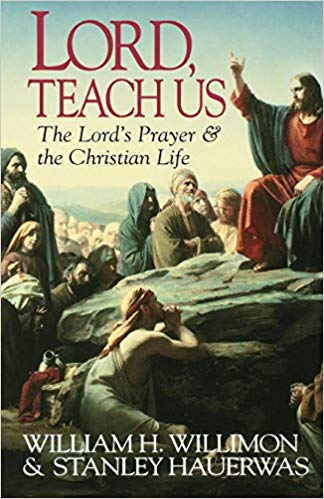 | Lord Teach Us to Pray Abingdon Press; Student/Study Guide edition (February 1, 1996). 112 pages. After a short introduction, the authors work through each phrase of the Lord's Prayer, using it as a framework for the Christian life. Providing basic faith understanding, this book will help the user experience Christianity as attractive and inviting, not distant, difficult, or foreboding. |
 | In Good Company: The Church as Polis University of Notre Dame Press; New edition edition (July 31, 1995). 288 pages. By exposing a different account of politics—the church as polis and "counterstory" to the world's politics—Stanley Hauerwas helps Christians to recognize the unifying beliefs and practices that make them a political entity apart from the rest of the world. |
 | God, Medicine, and Suffering Eerdmans; Later Printing Used edition (December 12, 1994). 168 pages. Why does a good and all-powerful God allow us to experience pain and suffering? According to Stanley Hauerwas, asking this question is a theological mistake. Drawing heavily on stories of ill and dying children to illustrate and clarify his discussion of theological-philosophical issues, Hauerwas explores why we so fervently seek explanations for suffering and evil, and he shows how modern medicine has become a god to which we look (in vain) for deliverance from the evils of disease and mortality. |
 | The Peaceable Kingdom: A Primer In Christian Ethics University of Notre Dame Press; 1 edition (August 31, 1991). 208 pages. Stanley Hauerwas presents an overall introduction to the themes and method that have distinguished his vision of Christian ethics. Emphasizing the significance of Jesus’ life and teaching in shaping moral life, The Peaceable Kingdom stresses the narrative character of moral rationality and the necessity of a historic community and tradition for morality. Hauerwas systematically develops the importance of character and virtue as elements of decision making and spirituality and stresses nonviolence as critical for shaping our understanding of Christian ethics. |
 | Character and the Christian Life: A Study in Theological Ethics University of Notre Dame Press; 1st edition (1994). 272 pages. Some fourteen years after its initial publication, this important and influential book, with a new, substantial, and candid introduction by the author, is available in a reasonably priced paperback edition. In this volume Hauerwas assesses recent interest in the “ethics of character” and suggests areas in his own work that now call for some corrective and/or further work. |
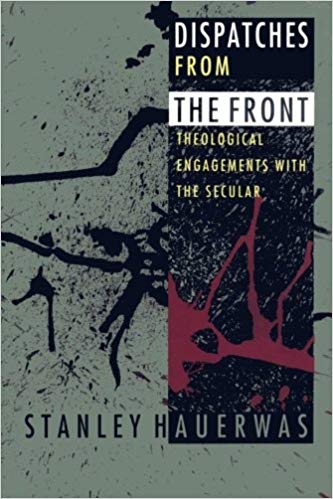 | Dispatches from the Front Duke University Press; 1st edition (May 20, 1994). 248 pages. At once Christian theology and social criticism, this book aims to show that the two cannot be separated. In this spirit, Hauerwas mounts a forceful attack on current sentimentalities about the significance of democracy, the importance of the family, and compassion, which appears here as a literally fatal virtue. In this time of the decline of religious knowledge, when knowing a little about a religion tends to do more harm than good, Hauerwas offers direction to those who would make Christian discourse both useful and truthful. Animated by a deep commitment, his essays exhibit the difference that Christian theology can make in the shaping of lives and the world. |
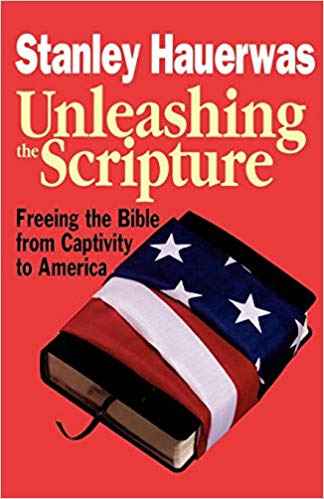 | Unleashing the Scripture: Freeing the Bible from Captivity to America Abingdon Press; 1st edition (October 1, 1993) 160 pages. This provocative critique of the uses and abuses of Scripture in the American church shows how liberal (historical-critical) and fundamentalist (literal) approaches to biblical scholarship have corrupted our use of the Bible. Hauerwas argues that the Bible can only be understood in the midst of a disciplined community of people, where the story is actually lived out by dedicated practitioners. |
 | Against The Nations: War and Survival in a Liberal Society University of Notre Dame Press; New edition edition (September 30, 1992). 208 pages. Against the Nati. 208 pages.ons is Stanley Hauerwas's most wide-ranging and sustained effort to develop a uniquely Christian ethic. The book moves from such general themes as "Keeping Theological Ethics Theological" and "Keeping Theological Ethics Imaginative" to the application of these themes to such diverse topics as the Holocaust, Jonestown, the reality of the Kingdom, the reality of the Church, the democratic state, nuclear war, and disarmament. |
 | A Community of Character: Toward a Constructive Christian Social Ethic University of Notre Dame Press; 1 edition (January 31, 1991). 312 pages. Leading theological ethicist Stanley Hauerwas shows how discussions of Christology and the authority of scripture involve questions about what kind of community the church must be to rightly tell the stories of God. He challenges the dominant assumption of contemporary Christian social ethics that there is a special relation between Christianity and some form of liberal democratic social system. |
 | After Christendom Abingdon Press (October 1, 1991). 200 pages. Liberal/conservative and modern/postmodern concepts define contemporary theological debate. Yet what if these categories are grounded in a set of assumptions about what it means to be the church in the world, presuming we must live as though God's existence does not matter? What if our theological discussion distracts us from the fact that the church is no longer able to shape the desires and habits of Christians? Hauerwas wrestles with these and similar questions constructing a theological politics necessary for the church to be the church in the world. In so doing, he challenges liberal notions of justice and freedom. |
 | Suffering Presence "Stanley Hauerwas challenges the dominant paradigms of contemporary ethics and views the moral crisis in medicine in this excellent collection of essays. He provides fresh insights into such diverse issues as whether the goal of medicine is to forestall death, how moral relations in a family may be redefined in response to novel reproductive techniques, and whether there are limits to the duties of parents of children who are disabled." --Cynthia B. Cohen, Ph.D., J.D., The Hastings Center |
 | Vision and Virtue: Essays in Christian Ethical Reflection University of Notre Dame Press (April 30, 1981). 264 pages. Describing Hauerwas' work as Christian ethics, one can allow that phrase its full scope of meaning. It is the work of an ethician, who is thoroughly conversant with that branch of philosophy and comes to grips with its major issues. He is also firmly committed to the view that, in modifying the substantive 'ethics' with the adjective 'Christian, ' one is designating a distinct reality. |
 | Truthfulness and Tragedy: Further Investigations in Christian Ethics University of Notre Dame Press; 1 edition (September 30, 1977). 256 pages. In Truthfulness and Tragedy Stanley Hauerwas provides an account of moral existence and ethical rationality that shows how Christian convictions operate, or should operate, to form and direct lives. In attempting to conceptualize the basis of Christian ethics in a manner that will render Christian convictions morally intelligible, the author casts fresh light on traditional theoretical issues and articulates the distinctive Christian response to contemporary concerns such as suicide, medical ethics, and child care. The first section of the book deals with methodological issues: the meaning and nature of practical reason, obligation claims, natural law, and self deception, and the affinity of story and ethics. It focuses on the relation of truthfulness and tragedy and the need for a story―a set of religious convictions or “grammar of theology”―that does justice to the tragic character of human existence. The second section addresses substantive issues: suicide, euthanasia, and the value of survival; the moral limits of population growth; the definition of “person” for medical reasons; and social involvement and Christian ethics. The overall theme is the need for a community in which truthfulness is a way of life. In the final section, devoted to the problem of how to care for retarded children, the implications of the author’s ethical position are given concrete expression. He discusses the assumptions underlying the willingness to have children, criteria for humanness, medical ethics, and how truthful communities deal with suffering. In Truthfulness and Tragedy Stanley Hauerwas extends and clarifies the ethical position set forth in his earlier books Character and the Christian Life and Vision and Virtue. He is associate professor of theology at the University of Notre Dame. He was a senior fellow in Christian medical ethics at the Joseph and Rose Kennedy Institute for the Study of Reproduction and Bioethics, and taught medical ethics at the University of Texas medical branch in Galveston. |
Books by Stanley Hauerwas

Books on Hauerwas
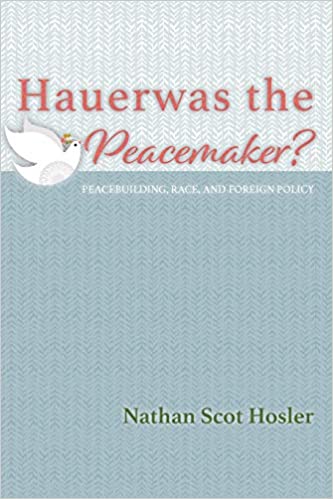 | Hauerwas the Peacemaker?: Peacebuilding, Race, and Foreign Policy by Nathan Scot Hosler Pickwick Publications (April 14, 2020). 290 pages. “War has been abolished in Christ” is a strong claim by theologian Stanley Hauerwas. Wars, however, continue to rage, and historic numbers of people are displaced globally. Despite critics’ assessments that Hauerwas contributes to Christians disengaging, his work provides certain tools for the work of peacebuilding. In this work, Hauerwas’s contribution to peacemaking as a part of his ecclesiology and broader theological/ethical work will be assessed. Hauerwas’s peacemaking within his work stands within the context of ecclesiology and related themes of witness and Christology. The possibilities of his work on peacemaking to extend to peacebuilding practice and foreign policy formation are explored, and a critique is leveled regarding his engagement with racial justice. Additionally, certain practices of reading in theology and training in this language are extrapolated to engage the task of policy formation and analysis in contexts where religion is an active factor. This study concludes that Hauerwas’s theological ethics of peacemaking makes a valuable contribution, but must be extended into specific practices. |
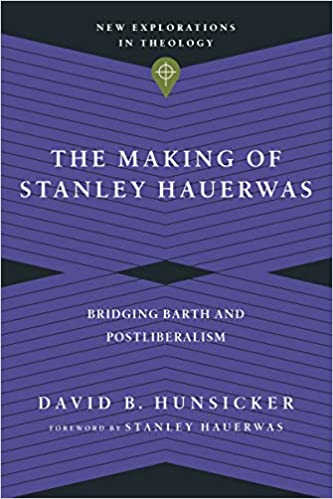 | The Making of Stanley Hauerwas: Bridging Barth and Postliberalism (New Explorations in Theology) by David B. Hunsicker (Author), Stanley Hauerwas (Foreword). IVP Academic (September 10, 2019). 248 pages. In the past half-century, few theologians have shaped the landscape of American belief and practice as much as Stanley Hauerwas. His work in social ethics, political theology, and ecclesiology has had a tremendous influence on the church and society. But have we understood Hauerwas's theology, his influences, and his place among the theologians correctly? Hauerwas is often associated―and rightly so―with the postliberal theological movement and its emphasis on a narrative interpretation of Scripture. Yet he also claims to stand within the theological tradition of Karl Barth, who strongly affirmed the priority of Jesus Christ in all matters and famously rejected Protestant liberalism. These are two rivers that seem to flow in different directions. In this volume within IVP Academic's New Explorations in Theology (NET) series, theologian David Hunsicker offers a reevaluation of Hauerwas's theology, arguing that he is both a postliberal and a Barthian theologian. In so doing, Hunsicker helps us to understand better both the formation and the ongoing significance of one of America's great theologians. |
 | The Church in a Secular Age: A Pneumatological Reconstruction of Stanley Hauerwas’s Ecclesiology by Silje Kvamme Bjørndal (Author), Amos Yong (Foreword) Pickwick Publications (September 20, 2018) 232 pages. How can the church navigate the challenges of our secular age? In The Church in a Secular Age, Norwegian and Pentecostal scholar Silje Kvamme Bjørndal takes on three dynamic thinkers, each in their own way, in search for insights to this question. Philosopher Charles Taylor offers the backdrop for the conversation, as Bjørndal carefully sifts out some of his most central tenets for understanding our secular age. Bjørndal then turns to the theologian and ethicist Stanley Hauerwas and critically engages his notion of the church as a community set apart from our secular age. By bringing several of Hauerwas’s interlocutors into the conversation, Bjørndal manages to bring out both the acute relevance and the shortcomings of his ecclesiology. Thus, she finds that another turn is needed in order to offer a concrete, as well as creative, contribution to this ecclesiological conversation. Considering the undeveloped pneumatological undercurrent in Hauerwas’s work, it proves fruitful to engage the leading Pentecostal scholar Amos Yong and his foundational pneumatology. This engagement results in a shift of agency, from the community to the Spirit. And keeping up the dialogue with Taylor’s secular age, Bjørndal demonstrates how the Spirit’s agency is crucial for the church as it attempts to navigate the particular challenges (and opportunities) of a secular age. |
 | Virtue Ethics and Moral Knowledge: Philosophy of Language after MacIntyre and Hauerwas by R. Scott Smith Routledge; 1 edition (May 18, 2017) 240 pages. We live in a time of moral confusion: many believe there are no overarching moral norms, and we have lost an accepted body of moral knowledge. Alasdair MacIntyre addresses this problem in his much-heralded restatement of Aristotelian and Thomistic virtue ethics; Stanley Hauerwas does so through his highly influential work in Christian ethics. Both recast virtue ethics in light of their interpretations of the later Wittgenstein's views of language. This book systematically assesses the underlying presuppositions of MacIntyre and Hauerwas, finding that their attempts to secure moral knowledge and restate virtue ethics, both philosophical and theological, fail. Scott Smith proposes alternative indications as to how we can secure moral knowledge, and how we should proceed in virtue ethics. |
 | The Ecclesiology of Stanley Hauerwas: A Christian Theology of Liberation (Routledge New Critical Thinking in Religion, Theology and Biblical Studies) by John B. Thompson Routledge; 1 edition (March 1, 2017). 256 pages. This book presents the theological work of Stanley Hauerwas as a distinctive kind of 'liberation theology'. John Thomson offers an original construal of this diffuse, controversial, yet highly significant modern theologian and ethicist. Organising Hauerwas' corpus in terms of the focal concept of liberation, Thomson shows that it possesses a greater degree of coherence than its usual expression in ad hoc essays or sermons. John Thomson locates Hauerwas in relation to a wide range of figures, including the obvious choices - Rauschenbusch, Niebuhr, Barth, Yoder, Lindbeck, MacIntyre, Milbank and O'Donovan - as well as less expected figures such as Gadamer, Habermas, Ricoeur, Pannenberg, Moltmann, and Hardy. Providing a structured and rigorous outline of Hauerwas' intellectual roots, this book presents an account of his theological project that demonstrates an underlying consistency in his attempt to create a political understanding of Christian freedom, reaching beyond the limitations of the liberal post-enlightenment tradition. Hauerwas is passionate about the importance of moral discourse within the Christian community and its implications for the Church's politics. When the Church is often perceived to be in decline and an irrelevance, Hauerwas proffers a way of recovering identity, confidence and mission, particularly for ordinary Christians and ordinary churches. Thomson evaluates the comparative strengths and weaknesses of Hauerwas' argument and indicates a number of vulnerabilities in his project. |
 | Beginnings: Interrogating Hauerwas by Brian Brock (Author), Stanley Hauerwas (Author), Kevin Hargaden (Editor) T&T Clark (February 9, 2017). 366 pages. Stanley Hauerwas is arguably the most well-known figure in theological ethics of the last generation. Having published voluminously over the last 30 years, late in his career he has also published two volumes of essays discussing his corpus retrospectively, as well as a widely acclaimed memoir. The sheer volume of his work can be daunting to readers, and it is easy to get the impression that his retrospective volumes are restating positions developed earlier. Brian Brock delves into Hauerwas' formation as a theologian at Yale, his first book, Character and the Christian Life, and examines some of his early, and outspoken, criticisms of the guild of Christian ethics. This chapter is followed by a discussion of his memoir, Hannah's Child, and raises tricky questions about the role of autobiography in Christian ethics, as well as the troubling problem of race in the modern academy. Brock explores Hauerwas' work on disability, his criticisms of the discipline of medical ethics, and the role played by vulnerability in his work. The next chapter examines his views on just war and pacifism, here probing the sensitive issue of the role of gender in his work, and leading into a discussion on the nature of the church's peaceable politics, in which his supposed hyper-ecclesiocentricism is examined. Brock examines the role of virtue in Hauerwas' thought, and teases out why he hates to be called a virtue ethicist. A final chapter asks him to respond to the recently levelled criticism that scripture does no work in his theology, focusing especially on his under-appreciated commentary on the gospel of Matthew. The editor of this volume has managed to maneuver Hauerwas into positions where he has directly faced tricky questions that he normally does not discuss, such as the accusation that he is racist, too soft on Yoder, or misogynist. |
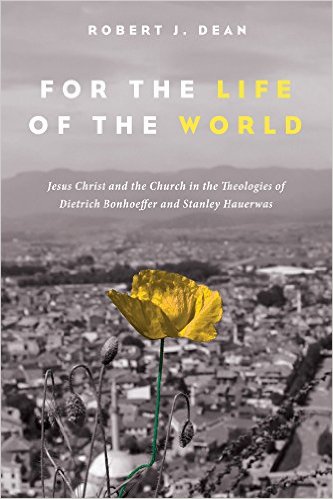
| | For the Life of the World: Jesus Christ and the Church in the Theologies of Dietrich Bonhoeffer and Stanley Hauerwas by Robert J. Dean. Pickwick Publications (May 13, 2016). 302 pages. What is the church? What is its mission in the world? Modern Protestantism's inability to provide a clear answer to these seemingly simple questions has resulted in vast confusion amongst pastors about the nature of their calling and has left congregations languishing without a clear reason for existence. Many of the voices and allegiances competing for the churches' attention have rushed in to fill the void, with the result that the church in modernity has frequently found itself captive to the prevailing culture. Yet from within the belly of highly culturally accommodated churches, both the German nepastor-theologian Dietrich Bonhoeffer and the American theological ethicist Stanley Hauerwas were able to articulate compelling visions of churches freed from their cultural captivity in order to truly and freely serve God and neighbor. Against the complex and confusing backdrops of Nazi Germany and late twentieth- and early twenty-first-century America respectively, Bonhoeffer and Hauerwas sought to recover the ethical and political character of the Christian faith through recalling the church back to the christological center of its faith. Together they provide a rich set of complementary, and at times mutually correcting, resources for the contemporary church as it seeks to faithfully bear witness to Christ amidst the ruins of Christendom. |
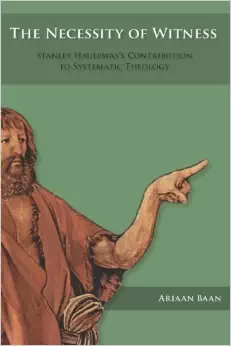 | The Necessity of Witness: Stanley Hauerwas's Contribution to Systematic Theology by Ariaan W. Baan. Pickwick Publications (August 17, 2015). 246 pages. The role of witness is a recurring theme in the work of Stanley Hauerwas: it is through enacting the truth in a world of lies, through seeking peace in a world of violence, that witnesses show who God is, who we are, and what the world is like. The Necessity of Witness is a study of Hauerwas and his fascinating but complex understanding of witness. Ariaan W. Baan argues that Hauerwas's approach makes a significant contribution to current debates in systematic theology on the relation between truth and life. Reading Hauerwas can be a precarious adventure. His rhetoric is overwhelming, but his argument is not always crystal clear and carefully formulated. With the help of semiotic and philosophical analysis and biblical exegesis, Baan articulates Hauerwas's intuitions, fills some of the gaps in his argumentation, and discloses hidden biases. The results of this analysis sometimes surprise. Baan notes that unexpected pericopes in Scripture such as Isaiah and Revelation support Hauerwas's account of witness, and concludes that his work offers insight into how in our late modern society such diverse groups as martyrs and pop stars offer implicit witness through their lives. |
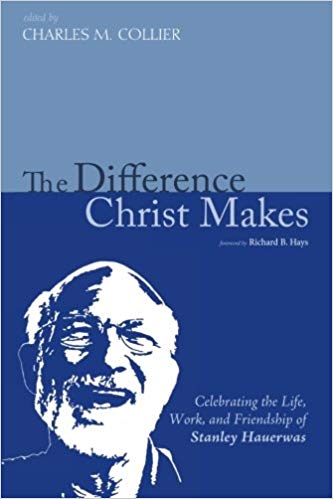 | The Difference Christ Makes by Charlie M. Collier Wipf and Stock (January 7, 2015). 114 pages. "The papers and responses in this volume were delivered, fittingly, on All Saints Day, 2013, as part of a day-long event to celebrate the career of Stanley Hauerwas, upon the occasion of his retirement from the faculty of Duke Divinity School. . . . [T]he central message of the day was encapsulated in the theme of the whole event: ""The Difference Christ Makes."" As the different speakers talked about Stanley's paradigm-changing impact on scholarship, one insight came ever more clearly into focus: the deepest theme of Stanley's work, the consistent thread running through all his thought, is his emphasis on the centrality of Jesus Christ. At the end of the day, his work is not defined by the ethics of character, or by pacifism, or by countercultural communitarian ecclesiology. All these elements play important roles in his writings, but they are reflexes or consequences of his more fundamental commitment to think rigorously about the implications of confessing Jesus Christ as Lord."" --from the foreword by Richard B. Hays |
 | Witness Is Presence: Reading Stanley Hauerwas in a Nordic Setting by Miika Tolonen Resource Publications (January 7, 2014). 200 pages. In a postsecular cultural situation the conditions for understanding and communicating a Christian tradition have changed. None of the established religions can any longer claim monopoly in the "marketplace of religions" A claim of this study is that a postsecular situation characterized, among other things, by dwindling memberships in established churches as well as a new visibility of alternative religious expressions, opens up a need to reflect on alternative ways of understanding Christianity in its context. This study focuses on the question, how can a Christian tradition be communicated understandably in a postsecular context? In traditional terms: how can Christian witness be understood in our situation? It is to this need, according to this study, that the ecclesiology of Stanley Hauerwas provides a meaningful perspective. This perspective becomes relevant because in a postsecular context a Christian church, even a folk church, cannot assume to be in a position of majority or power. There is, therefore, a need to ask how to understand Christianity as a community of witness that is neither in power nor a majority. The study suggests that embodiment of Christian convictions becomes a central factor in a meaningful postsecular notion of witness. |
 | Hauerwas: A (Very) Critical Introduction by Nicholas M. Healey. by Nicholas M. Healy. Eerdmans (March 14, 2014). 160 pages. Stanley Hauerwas is one of the most important and robustly creative theologians of our time, and his work is well known and much admired. But Nicholas Healy -- himself an admirer of Hauerwas’s thought -- believes that it has not yet been subjected to the kind of sustained critical analysis that is warranted by such a significant and influential Christian thinker. As someone interested in the broader systematic-theological implications of Hauerwas’s work, Healy fills that gap in Hauerwas: A (Very) Critical Introduction. After a general introduction to Hauerwas’s work, Healy examines three main areas of his thought: his method, his social theory, and his theology. According to Healy, Hauerwas’s overriding concern for ethics and church-based apologetics so dominates his thinking that he systematically distorts Christian doctrine. Healy illustrates what he sees as the deficiencies of Hauerwas’s theology and argues that it needs substantial revision. Reviews
|